Some years pass without leaving a mark. 2026 will not be one of them.
In the space of a few months, scientists finished the first wiring maps of entire brains, and machines learned to conjure whole worlds from a sentence. On 3 September 2026, a team from Google Research, HHMI Janelia and the University of Cambridge published the complete connectome of a male fruit fly's central nervous system in Cell — roughly 166,000 neurons and around 125 million connections, the largest brain map by neuron count to date. It followed the 2024 FlyWire map of the female fly brain — 139,255 neurons and about 50 million synapses — published in Nature. For the first time, we can hold the full wiring diagram of a thinking creature in our hands.
At almost the same moment, AI began writing worlds instead of reading them. Google DeepMind's Genie 3 turns a line of text into an explorable, real-time environment you can walk through; a system called Oasis generates a playable version of Minecraft frame by frame, with no game engine underneath — just a model imagining what should happen next.
We can now read biological intelligence and write synthetic worlds in the same season. It is genuinely astonishing. And it is also, quietly, a moment to pause.
I run a hospitality company, not an AI lab. But I read the people who build these systems, and their tone this year has changed. In a September 2026 opinion column for The Guardian, Alex Turner — a former Google DeepMind researcher — argued that the field is running "an extremely dangerous race towards superintelligent AI," and put his own estimate of an AI takeover at "roughly one-in-three." That is his personal view, not a measured probability. But it is striking coming from inside the building.
He is not alone in urging caution. Demis Hassabis, who leads Google DeepMind, called in February 2026 for research into AI's threats to be "done urgently," alongside "smart regulation" and "strong safeguards." Back in 2023, hundreds of researchers and executives — including the CEOs of OpenAI and Anthropic — signed a single-sentence statement that mitigating "the risk of extinction from AI should be a global priority."
I am not here to frighten anyone, and I don't think fear is the right response. Most of us will never touch the frontier of this technology. But you don't need to fear the tide to notice it's coming in — and to decide, calmly, where you want to be standing.
The opposite of a simulated world is not a better screen. It is a real place, a real morning, a real person across the table.
Here is what I keep coming back to. As machines get better at generating experiences, the value of an unmediated one goes up, not down. When any image can be conjured and any world rendered on demand, the thing that becomes rare — and precious — is the experience no algorithm sat between you and.
The research on how we actually feel bears this out. A short walk in nature improves directed attention by around 20% compared with the same walk through a city, according to a 2008 study in Psychological Science. A large 2019 study in Scientific Reports, following nearly 20,000 people, found that spending at least 120 minutes a week in nature was consistently linked to better health and wellbeing. These are not romantic notions. They are measurable effects of putting your body somewhere real.
Contrast that with where our attention has drifted. Dr Gloria Mark of UC Irvine has tracked how long we spend on a single screen before switching: it has fallen to roughly 47 seconds. Her and others' work suggests that even the presence of a smartphone — face down, switched off — measurably reduces working memory and available attention. A 2025 MIT Media Lab preprint on people writing with and without a chatbot found that heavy AI users showed weaker neural engagement and remembered less of their own work — what the authors called "cognitive debt." It's early research on a small group, so I hold it loosely. But it rhymes with something most of us already feel: the more we outsource, the less present we are.
That is not an argument against technology. It's an argument for choosing, deliberately, the hours in which you switch it off.
You can see the counter-current everywhere. Vinyl records outsold CDs again in 2024, their eighteenth straight year of growth. Teenagers in Brooklyn started a "Luddite Club" and traded smartphones for flip phones. Film photography is back in the hands of a generation that never shot it the first time. None of this is nostalgia for a worse life. It is people reaching, instinctively, for things with weight and grain — for the real.
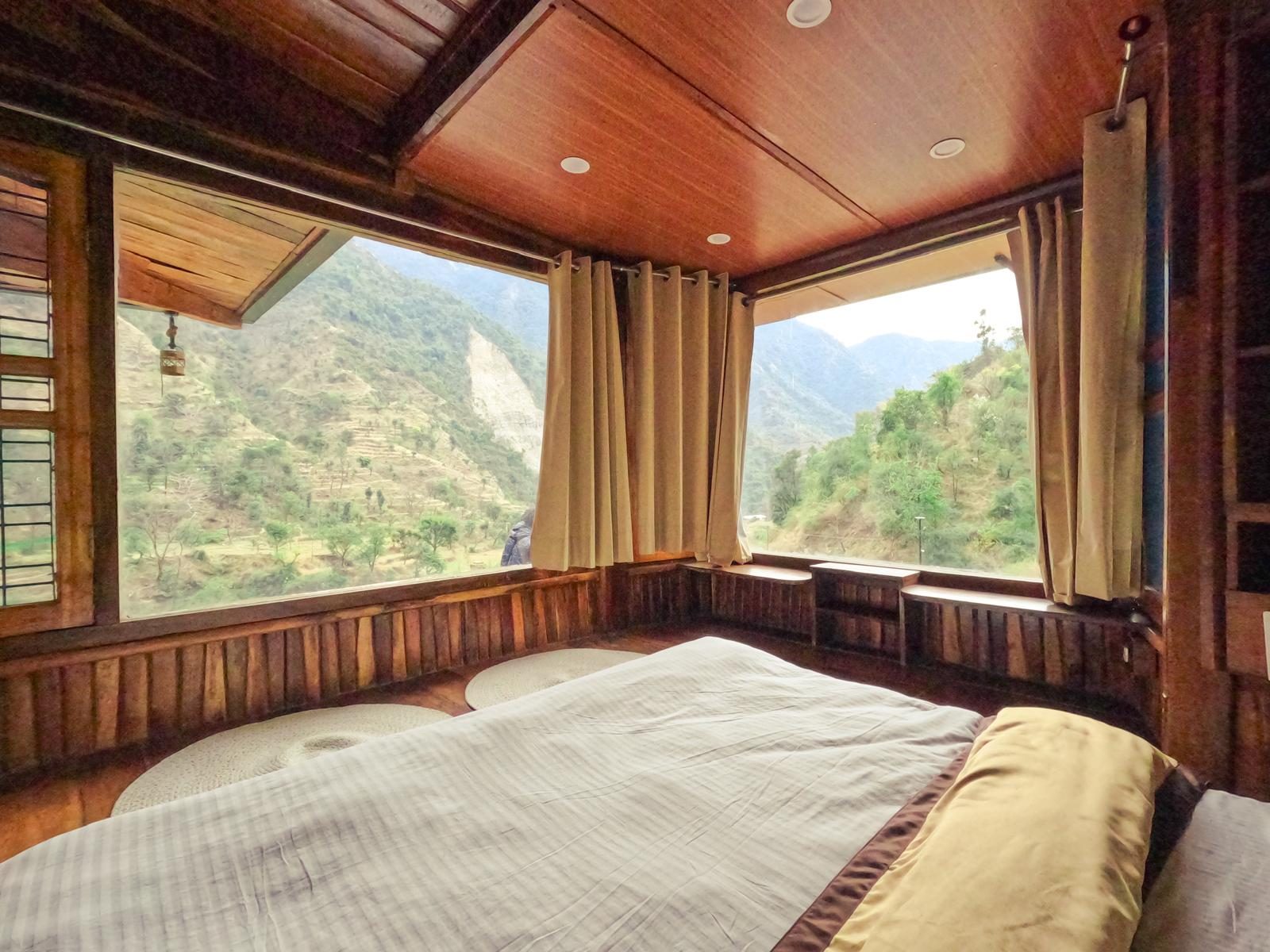
This is the work we've quietly been doing all along. At Kaksh Villa, our private villa near Sahastradhara in Dehradun, mornings arrive the old way: mist on the hills, birdsong instead of notifications, a pool and a garden and no reason to hurry. At Ark Inn, our boutique hotel, hospitality still means a person who knows your name, not a system that predicts your preferences. Up in Tosh, at nearly 8,000 feet, the mountains handle the digital detox for you — the signal simply gives out, and the glaciers take over.
We didn't design these places as an escape from AI. We designed them for presence, because presence is what a good life is made of. It just so happens that presence is also the one thing no model can generate for you. A world rendered from a prompt can be extraordinary. It cannot be yours — a specific morning, in a specific valley, with people you love, that happened only once.
So my invitation is simple, and it is the same one I'd have offered ten years ago, only more urgent now: come somewhere real. Walk a trail. Eat a slow breakfast. Have a conversation that no one is optimizing. Let the age of AI arrive — it will, whatever we do — and meet it as a person who still knows how to be somewhere, fully, with nothing between you and the world.
Is this an anti-technology message? Not at all. We use technology every day to run our properties well. The point is balance — deciding which parts of life are better left un-automated, and protecting them on purpose.
What does "living well in the age of AI" actually look like? Concretely: regular time outdoors, real conversations, hours with your phone genuinely out of reach, and experiences you seek out in person rather than on a feed. The evidence on nature and attention is encouraging, and none of it requires a retreat from modern life — just intention.
Where can I do this near Dehradun? Kaksh Villa (private stays near Sahastradhara), Ark Inn (our boutique hotel), and our mountain café and inn in Tosh, Parvati Valley, are all built around exactly this — being somewhere real, unhurried, and present.
We're part of a small family of brands, and several of us wrote this month about what AI means for the things we care about:
Stories, offers, and updates from Musée Living — no spam, just things worth reading.