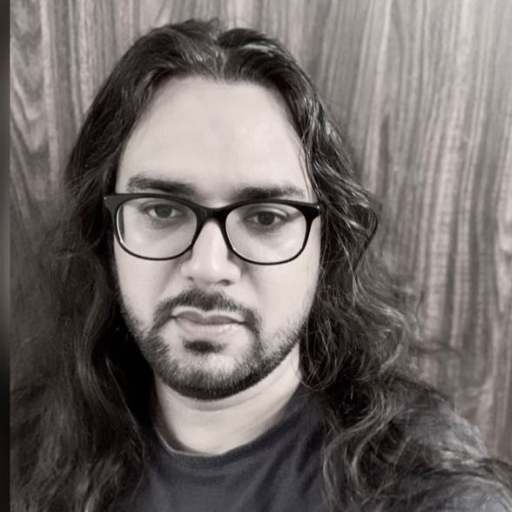

There is something quietly defiant about a hand-painted mountain village in a world increasingly filled with algorithm-generated landscapes. Tripti Kharkwal, an artist working out of India, creates precisely that kind of defiance — warm, textured, unmistakably human work that draws you into the folds of the Himalayan foothills and the quiet dignity of everyday life there.
Kharkwal works across various mediums, and while she hasn't offered an artist's statement in words, her canvases speak plainly enough. Her piece "Night light" (INR 18,000) carries a hush to it — the kind of stillness that only comes from someone who has actually sat outside at dusk and watched the color drain from the sky, brush in hand, patiently mixing shadow from memory rather than pulling it from a color palette generated in an instant. In "Face of pahad" (INR 13,000), she turns her attention to the mountains themselves — not as scenery, but as something with character, weathered and watchful, rendered with the kind of intimacy that suggests years of actually looking, not scanning. And in "Traditional Kumaoni house, Almora Bazaar" (INR 18,500), Kharkwal captures a piece of architectural heritage with a tenderness that borders on documentation — preserving, through paint, a corner of Uttarakhand that might otherwise only exist in old photographs and older memories.
What strikes you across all three works is restraint. Nothing is exaggerated for effect. There's no algorithmic flourish, no uncanny perfection. Instead, there's the trace of a hand that hesitated, corrected, layered, and ultimately decided — a hundred small human choices stacked into a single finished image.
And that, increasingly, is the point.
We are living through a moment when images can be summoned in seconds — trained on millions of photographs, stitched together by machines that have never smelled woodsmoke or felt mountain wind, never sat cross-legged for hours getting a doorway just right. AI-generated art is fast, endlessly available, and, in its own way, impressive. But it is also, fundamentally, hollow. It has no memory of Almora's bazaar streets, no relationship to the particular slant of light in the Kumaon hills at 5 pm in October. Tripti Kharkwal's work carries all of that. Her paintings aren't just images — they're records of attention, of a person choosing, again and again, to notice the world closely enough to translate it by hand. That labor, that intimacy, cannot be prompted into existence. It has to be lived.
This is precisely why platforms and spaces that champion real, human-made art matter more than ever. At Musée Art Cafe, we've long believed that art created by human hands — with all its imperfection and intention — deserves a place of honor, not nostalgia. Artists like Kharkwal are why that belief holds.
While Tripti Kharkwal is not currently accepting commissions, her existing body of work stands as a quiet, confident argument for handmade art in an increasingly synthetic visual world.
View Tripti Kharkwal's full portfolio on Kalacube


Tripti Kharkwal is one of 480+ artists on Kalacube — India's art marketplace by Musée Living. Every artwork you see here was made by human hands, not algorithms.
Explore more artists at Musée Art Cafe in Dehradun, where original art lives on every wall.
Stories, offers, and updates from Musée Living — no spam, just things worth reading.