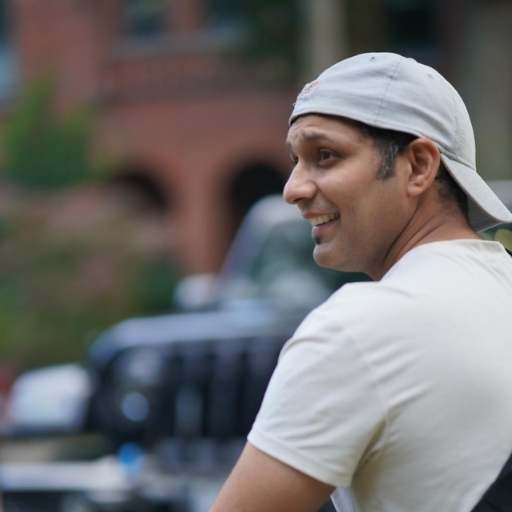

There is a particular kind of patience that lives in the fingertips of an artist who works across mediums—the willingness to fail with charcoal before succeeding with ink, to abandon a canvas and return to it weeks later with fresh eyes. This is the patience that defines Kamal Thapa, an artist working out of India whose practice moves fluidly between forms, refusing to be pinned down to a single technique or tradition.
Thapa's versatility isn't a lack of focus—it's the opposite. It's the mark of someone who lets the artwork dictate its own medium, who trusts instinct over formula. In an era where so much visual content is generated instantly, at scale, without a single hesitation or false start, there's something almost radical about an artist who still works slowly, who still makes mistakes, who still discovers the piece as it emerges rather than commanding it into existence with a prompt.
Among the works currently featured in Thapa's growing portfolio are three untitled pieces—each simply called "Artwork," a modest, almost defiant naming choice in a world obsessed with branding and explanation. Perhaps that's the point. The pieces don't need elaborate titles or artist statements to justify their existence. They ask to be looked at, sat with, felt—not decoded. There's a humility in letting the work speak for itself, in trusting that the viewer will bring their own meaning to the encounter, the way art has always demanded of us.
We don't know yet what materials shaped these three pieces, what colors dominate their surfaces, or what story unfolds across them. What we do know is that they were made by hand, by a person, with all the imperfection and intention that implies. And in 2024, that fact alone carries weight.
This is why handmade art matters now more than ever. AI can generate a thousand images before you finish reading this sentence—technically proficient, stylistically coherent, utterly untouched by lived experience. What it cannot replicate is the tremor in a line drawn by someone who spent years training their hand to hold a brush just so. It cannot replicate the accumulated hours of failure that precede a single successful stroke, or the specific, unrepeatable moment when an artist decides this piece is finished and that one needs another week. Kamal Thapa's work—regardless of medium, regardless of title—carries the fingerprint of a real, searching, human mind. That fingerprint is not decorative. It's the entire point.
This is precisely the spirit that Musée Art Cafe was built to champion: spaces where real artists, working with real hands and real risk, are given room to be seen—not as content generators, but as makers. Places where the slow, deliberate act of creation is still honored as something worth gathering around.
Kamal Thapa's portfolio is still unfolding, and there is something exciting in that incompleteness—the sense of an artist mid-journey, still discovering which mediums will become their signature voice.
View Kamal Thapa's full portfolio on Kalacube
Kamal Thapa is one of 480+ artists on Kalacube — India's art marketplace by Musée Living. Every artwork you see here was made by human hands, not algorithms.
Explore more artists at Musée Art Cafe in Dehradun, where original art lives on every wall.
Stories, offers, and updates from Musée Living — no spam, just things worth reading.